B224B*
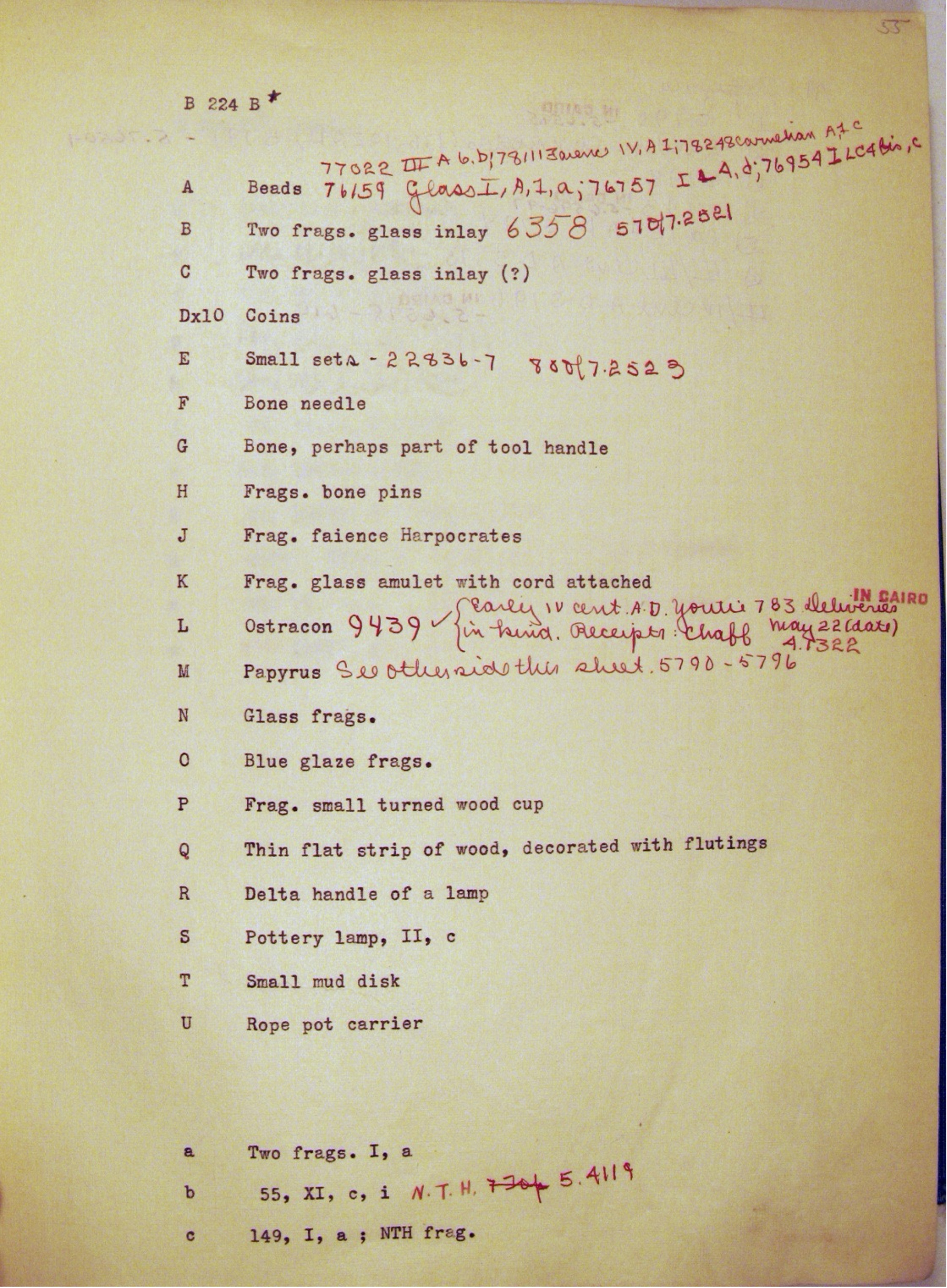
Placed at the top of the page, this header indicates the precise room with which the following objects were associated. The “official” designation, which was written on the artifacts, would also list the year, 1930, abbreviated as 30. The first B indicates the excavator identified “occupation layer."
The excavtors believed they could identify multiple periods of occupation at the site. The top or “A layer” represented the last period before abandonment, which they suggested was the fifth century. The “B Layer” was earlier, probably in the third century. 224 is the building number, while B represents the room. The asterisk indicates material found in a particular space, most likely under the floor level.
Artifact Designations
In the 1924 season, artifacts were assigned sequential capital letters (A–Z), with ceramics given lowercase letters, and objects of the same type grouped under a single designation. From 1925–26, Roman numeral suffixes were introduced to extend the system; if more than 26 artifacts were found in a particular locus, they would be numbered AI, BI, and so on. Peterson made further refinements from 1926–27 onward.
Annotations
This indicates that several beads were recovered in the unit. The annotation in red shows that six were discovered, given numbers 77022, 78113, 78248, 76159, 76757, and 76954. After each bead, a short description is provided, sometimes with a coded typology. For example, the second bead is made of faience, of type IV.A.1.
Two Frags, Glass Inlay
The first number, 6358, is the Kelsey Museum Accession Number. In the field, these two glass fragments were inscribed with the field number, 30- (the year) B224 (the building) B (the room), * (beneath floor level) -B (the artifact number).
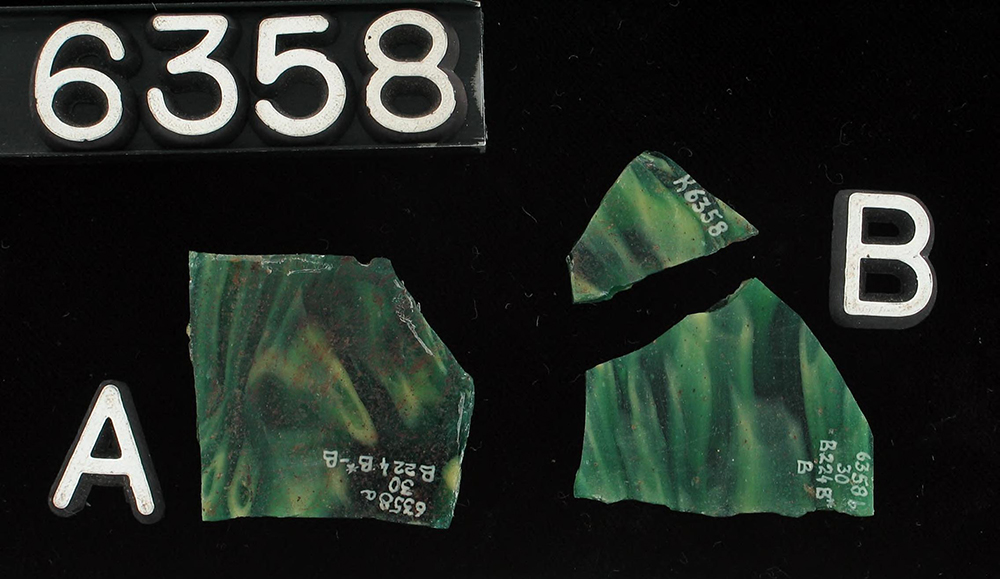
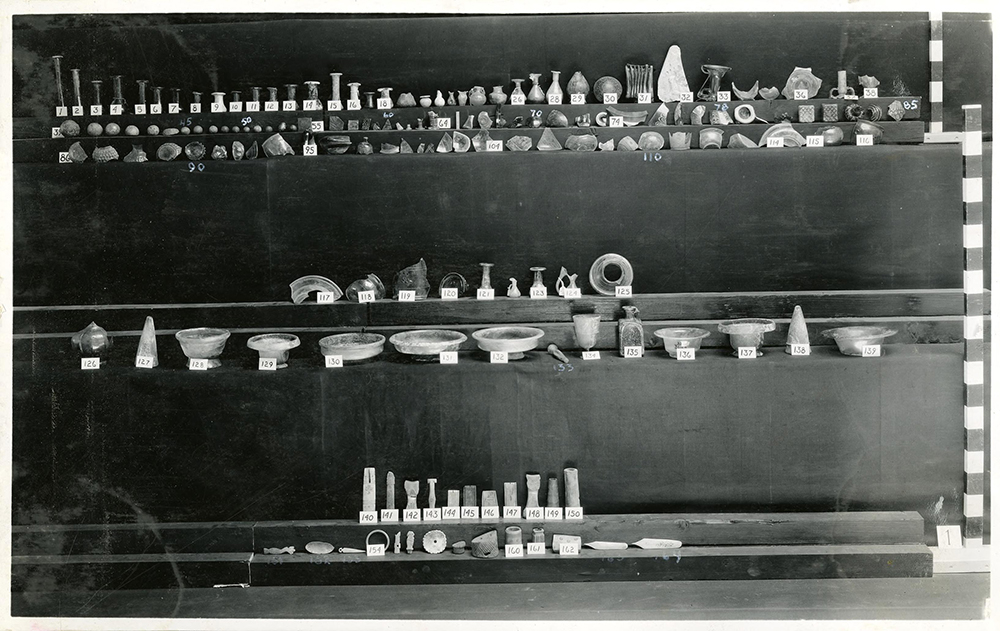
The second annotation, 5 of 7.2521, is a reference to a division photograph, taken before objects were divided between the University of Michigan and the Egyptian government. Shown with other glass fragments as number 5, the glass inlay is visible in the second row, two down from the number 55.
Objects Left in the Field
These objects, for which there are no further annotations, were likely left in the field. The Michigan team recorded the find, but it was not deemed sufficiently important to catalog or retain.
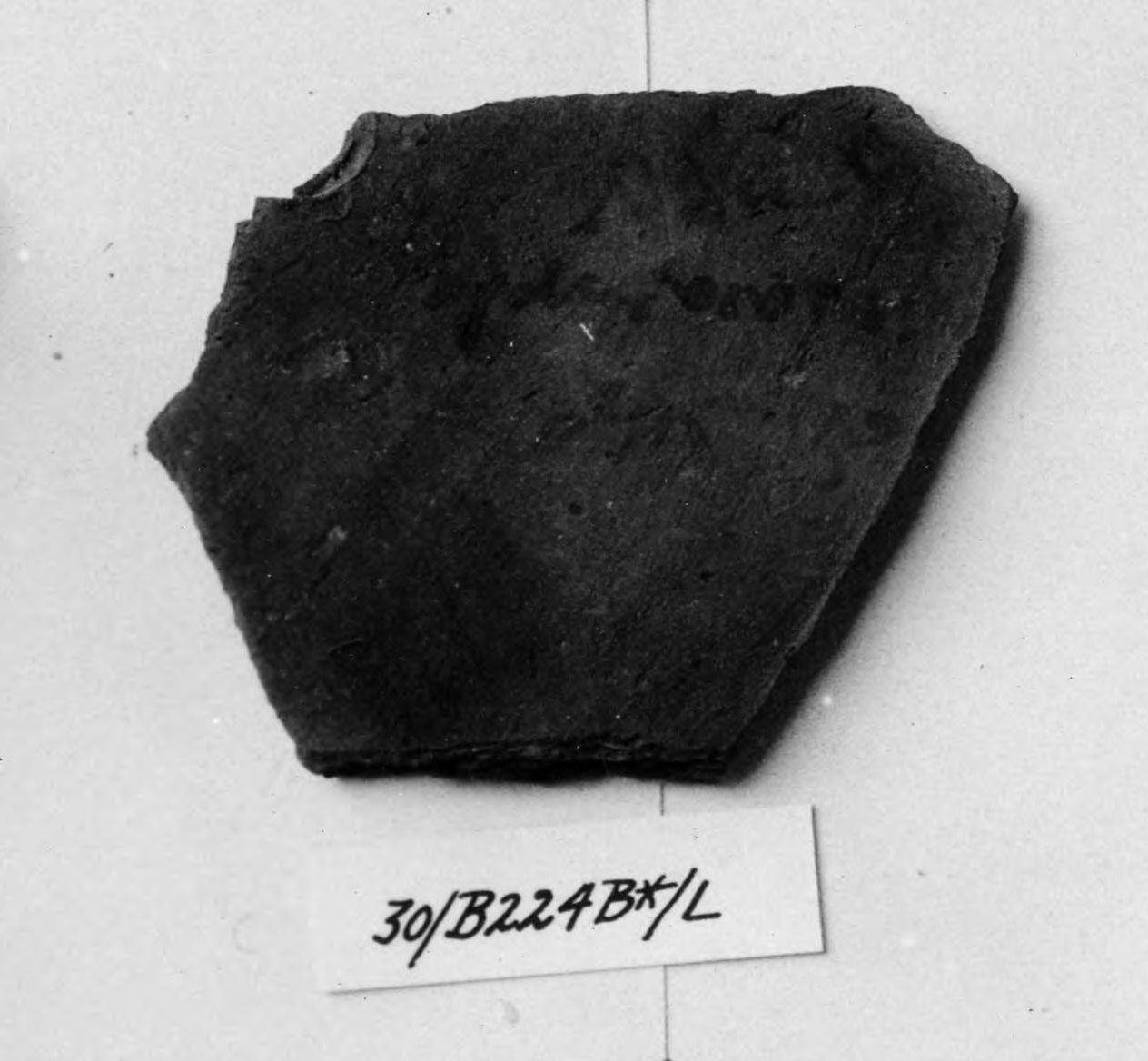
Ostracon
Cataloged as part of the University of Michigan Papyrus collection (view here), this ostracon, or inscribed potsherd, records the delivery of chaff to Karanis by an individual named Oualas.
The translation reads “On Pachon 27. Of Karanis. (Has paid) Oualas, 1 basket (sargane) of chaff."
Pottery Lamp
The lamp, like the beads (artifact A) and the ceramics shown below, were cataloged by typology number, following the best practices as suggested by the pre-eminent Egyptologist of the day, Flinders Petrie. The Karanis excavation employed a lamp typology that was probably borrowed in from the publications of the site of Ehnasya. Further work on this typology by the Karanis Housing Project team will provide additional insights into the meaning of this type listing.
Ceramic Vessel, Type 55
Ceramics were listed with lower case letters, and, after the first season, followed the pattern discussed above, where Roman numerals were appended to the lower case letters for artifact numbers above 26. Here, the ceramic vessel uses the ceramic typology as shorthand for the documentation.
This vessel is type 55. The remainder of the code provides a basic description of vessel, which is a bowl on a base ring with a moulded rim. The sides are carinated, with the carination at or above the middle of the vessel.
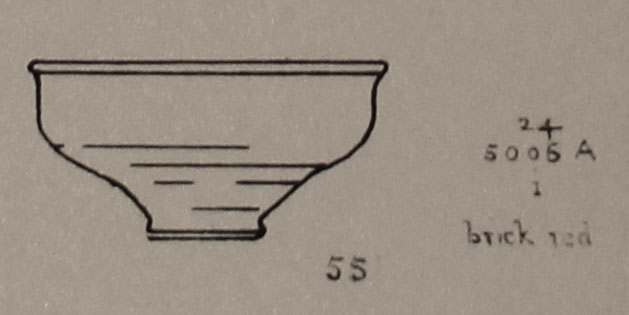
The sketch of the vessel helps to better identify it. The annotation to the side, NTH, indicates that the artifact was “Not Taken Home” or left in the field. More information on the ceramic typology can be found here.