Typologies
Following contemporary field practices in Egyptology established by Flinders Petrie, the Michigan team developed typologies to classify the artifacts they discovered and to make it easier to record the finds. Rather than describe every bed, lamp, or ceramic vessel, the excavators could quickly jot down a code.
The Karanis Ceramics
During the 1925-1926 season, A.G.K. Hayter, British archaeologist, developed a typology for the ceramic vessels. It is not clear who developed the other typologies in use at the site. The abbreviations for each type varied but typically included Arabic numbers (such as 401) or a series of Roman numerals and letters. Unluckily, in the years since the excavation closed, the “keys” for deciphering the typologies employed by the excavators were lost. Barbara Johnson, who published the ceramics from Karanis, did not refer to the excavator assigned numbers, and drawings created by the Michigan team were not used in either her publication or the later work of John Hayes.
In recent years, however, the archives have revealed one more secret: the pottery key. In the image below, the excavators have recorded an example of type 401 and have described what it should look like: a dish with a flat base and a plain rim. In the list of objects shown above from building B224, ceramic objects are enumerated by lower case letters. In the column on the right, the second object from the top, e, is listed as "401 VI a NTH". Here, "401" indicates the vessel type. "NTH" stands for "Not Taken Home," meaning that the artifact was left in the field and not retained by the excavation team. At a later date, the Michigan team developed a typology, in which the vessels were grouped according to physical characteristics, such as type VI, "Dishes with flat base".
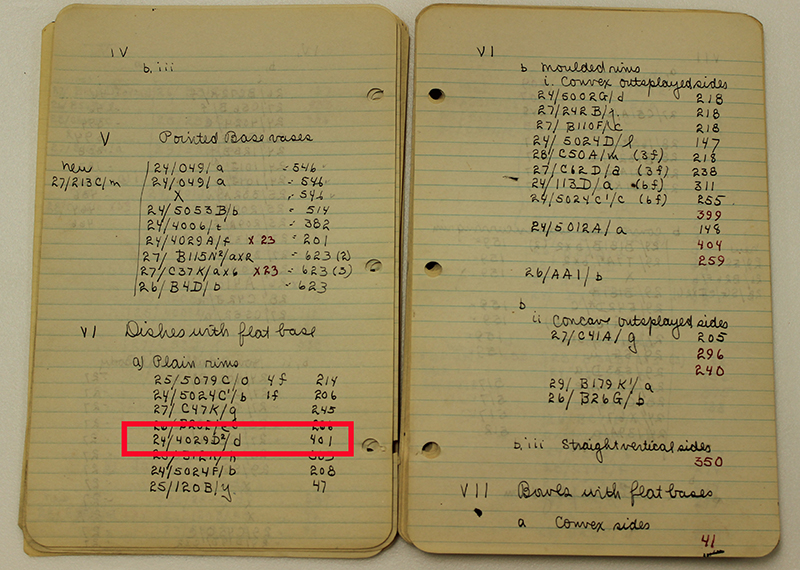
These numbers were also linked to profile drawings of each of the vessels. In the profile drawing for type 401, shown below, the notes indicate that that the vessel was made of fine red paste, with a red slip.
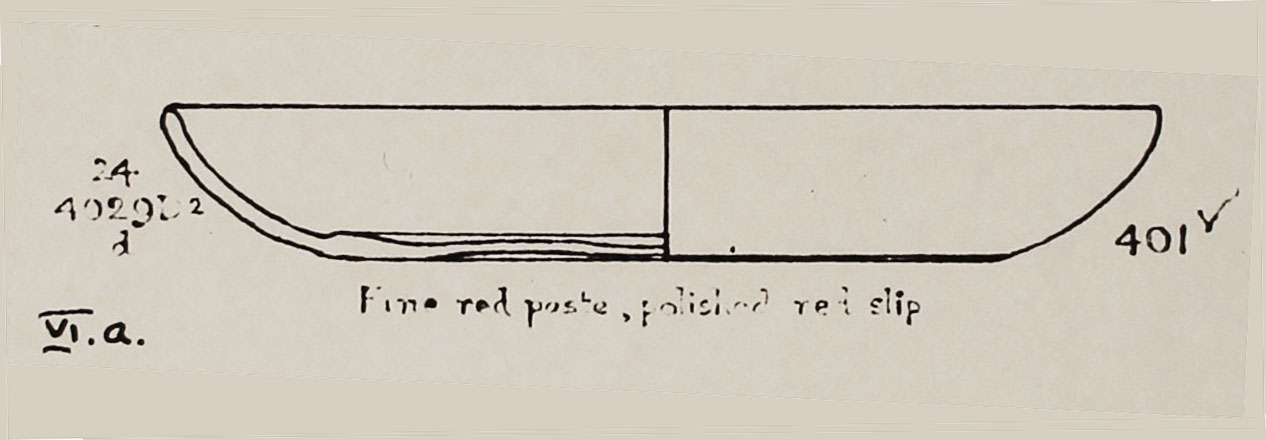
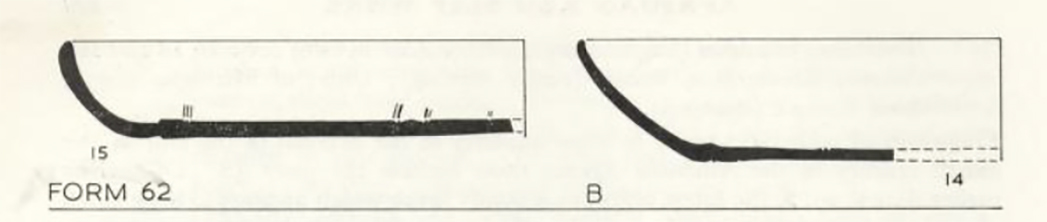
That vessel used for the drawing was taken back to Michigan and was accessioned into the collections as object 20975. John Hayes characterized this vessel as African Red Slip Type 62B, dating it to the end of the fourth century, 350-425 CE. (Hayes, Late Roman Pottery, 109) The profile drawing from Hayes is shown below. In Barbara Johnson's Pottery from Karanis, the vessel (catalogue number 213) was identified as African Red Slip and dated to the fourth or fifth century CE.
Now, ceramic specialists, including Thomas Landvatter (Reed College) and Nicholas Hudson (University of North Carolina – Wilmington) have been able to use the pottery key to re-assess the Karanis ceramics. As part of the Books of Karanis project, head by C. Michael Sampson (University of Manitoba), Nicholas Hudson has been re-analyzing the ceramics from the site using the key. The results of his work are being incorporated into the data for the Karanis Housing Project. The pottery types from Karanis can be browsed here.
The Karanis Lamps
The key for the lamps, however, has not been located. Archaeological Studies students at Oberlin College, including Sydney Fagerstrom (’22) and Chi Shu (’22) have begun the painstaking process of reconstructing the typology used for the lamps. The image below provides a tantalizing hint. It shows eight lamps, and the photograph includes the caption “8 lamp types; XVII; XVIII; XX and XXI".
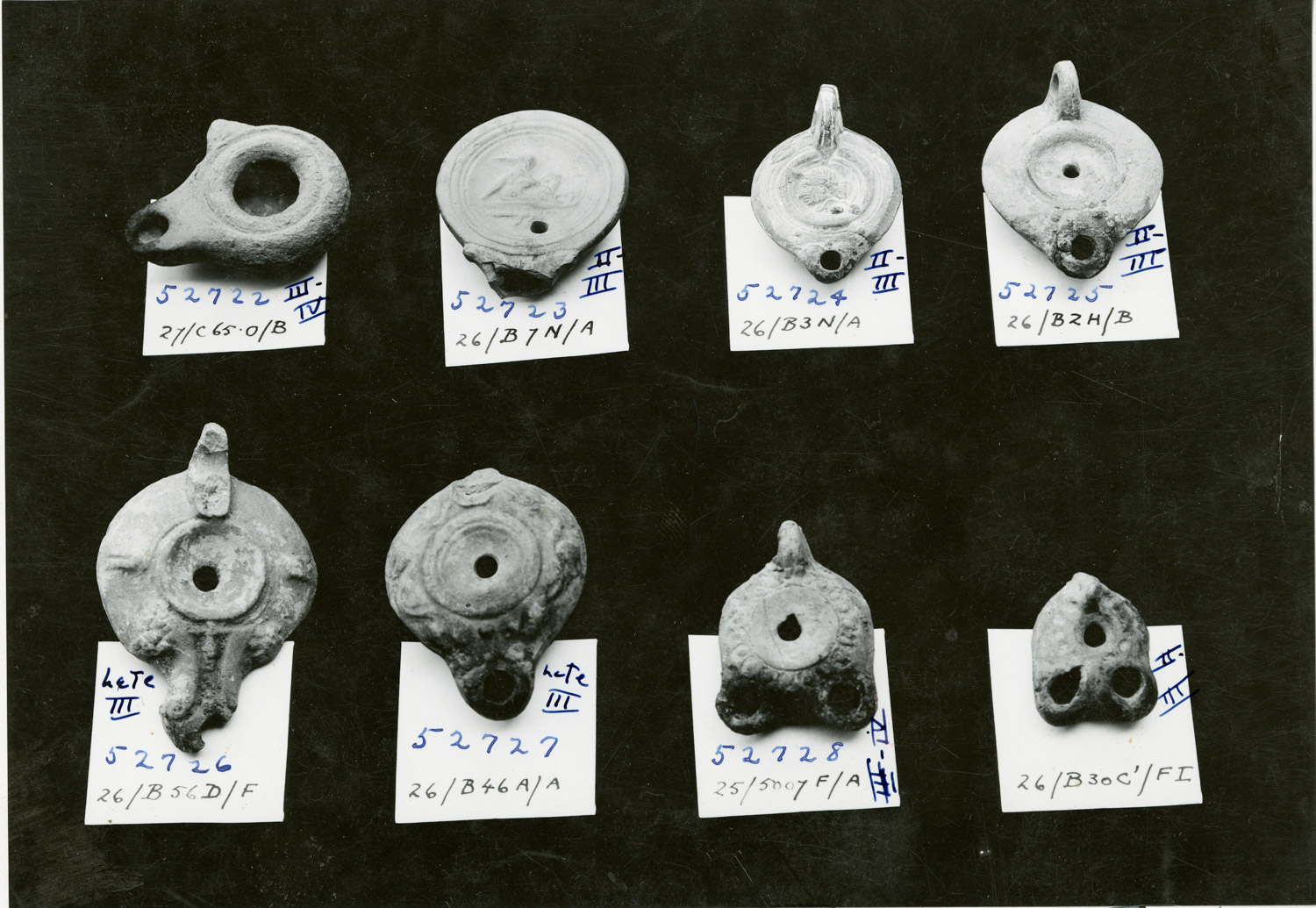
The work that they began is ongoing, but it is hopeful that these artifacts, too, will one day be better understood.
Bibliography
Hayes, J. W. (1972). Late Roman pottery. London: British School at Rome.
Johnson, B. (1981). Pottery from Karanis: Excavations of the University of Michigan. Ann Arbor: University of Michigan.
Landvatter, T. (2014). "Karanis Findspots and Stratigraphy." In T. G. Wilfong (ed.), Karanis Revealed (pp. 39-43). Ann Arbor: Kelsey Museum of Archaeology.